While my bright, beautiful, and charming wife doesn’t like to admit she married a geek, the truth is that I’m a complete nerd when it comes to statistics and trends in philanthropy.
This is the vocation to which I’ve dedicated my life. Anyone who is deeply committed to a calling needs to understand its nuances if they hope to perform their work at an optimal level. That’s a fancy way of admitting that I’m not talented enough to succeed on talent alone. I need to study my field if I’m going to have a fighting chance of doing my job reasonably well. Consequently, this seems like a good time to celebrate the 50th anniversary of the monumentally impactful, but largely forgotten, Filer Commission.
In the tradition of the legendary oil baron that was his namesake, John D. Rockefeller, III was one of the great philanthropists of mid-20th century America. After serving in the U.S. Navy in post-World War II Japan, he was central to the founding of the Asia society which promoted important educational and cultural exchanges between East and West. He was the leading philanthropic voice on the issue of family planning and the driving force behind the establishment of the Lincoln Center for the Performing Arts. Rockefeller’s charitable work was both broad and deep and thus he had a uniquely intuitive understanding of the critical importance of private philanthropy. Unfortunately, the United States Congress wasn’t nearly as enlightened.
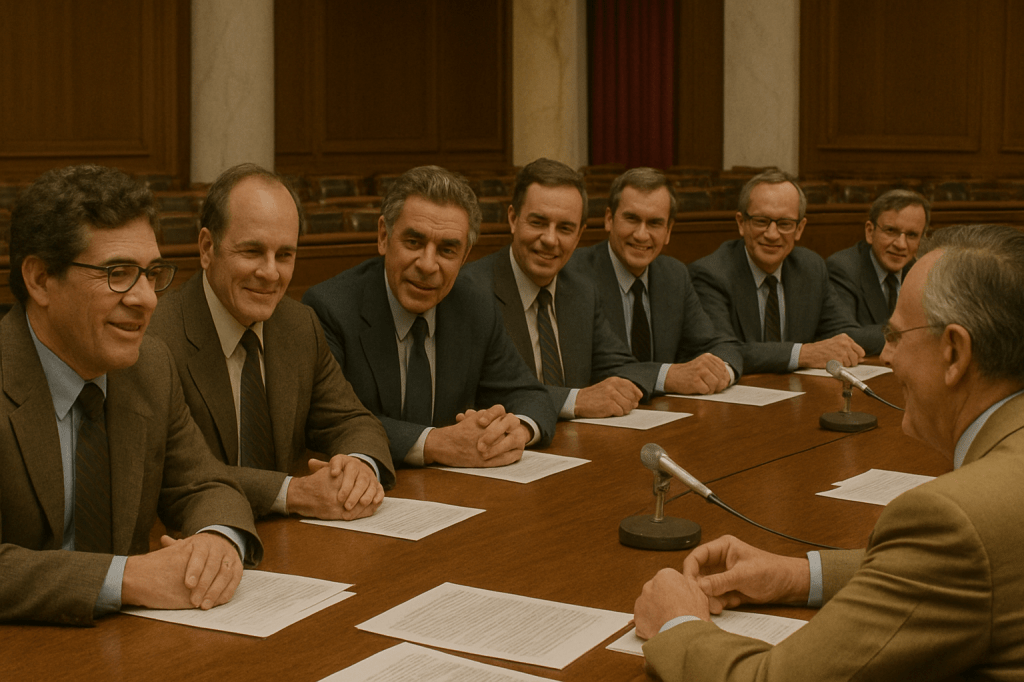
Through the early 1970s, both policy makers and politicians largely viewed American society as divided into government and private entities. If you weren’t a unit of government, you were a private entity whose purpose was the accumulation of wealth. That was reflected in both the tax and public policy of the day. Rockefeller recognized that charitable and philanthropic organizations didn’t fit into either of those two little boxes. These entities were designed to create a public benefit rather than make a profit, but they weren’t a part of government. They were something else.
While some governmental policies of the day aided this so-called “third sector,” there was also legislation which treated these organizations as if they were no different from private business interests. Rockefeller argued that these private philanthropic groups were different, but he was unable to articulate exactly how they were different nor quantify their impact on society. Thus, he set out to answer those questions.
Some fifty years ago, the Commission on Private Philanthropy and Public Needs was launched with the financial support of the Rockefeller family. It became known as the “Filer Commission” because it was chaired by Rockefeller’s colleague, Aetna Insurance CEO John Filer.
The Filer Commission was the first significant effort to study charitable giving and the entities that were recipients of this generosity. Over two years, more than a hundred leading economists, sociologists, and attorneys constituted an advisory committee that commissioned 85 research projects in education, healthcare, culture, and human services. It conducted the first national survey on the views of Americans on philanthropy. Their collective work was summarized in the report, “Giving in America: Toward a Stronger Voluntary Sector.”
The report argued that beyond the two traditional segments of society, government and private entities, there was also a third “volunteer sector” which played a key role in our national life. The research studies documented how the voluntary acts of Americans, from charitable giving to donations of time, offered no financial or tangible private benefits yet were essential to our nation’s well-being. Unfortunately, the tax and public policy framework of the time often treated this volunteer sector as if it were just another private business interest.
The Filer Commission first articulated the framework we still use today, differentiating between what we now think of us government, for-profit businesses, and non-profit organizations. It advocated for making permanent a tax deduction for charitable contributions we now enjoy and called for financial transparency which became the modern requirement that non-profit organizations publicly disclose their tax returns.
The Filer Commission also directly led to the creation of two organizations that still play a key role in philanthropy: the Independent Sector which “advocate[s] for public policies that strengthens non-profits” and the National Committee for Responsive Philanthropy that is “philanthropy’s critical friend and independent watchdog.”
Unquestionably, the Filer Commission was pivotal in shaping modern philanthropy and provided the strategic framework we still use fifty years later. Even today, its ideas guide the evolution of the non-profit sector, public policy, and the robust philanthropic environment that is essential to America’s way of life.
This column originally appeared in the Peninsula Pulse on May 3, 2024.
 Bicoy Philanthropic Advisors